Greetings,
After transcribing my 6,000+ word interview with Mr Shaun Micallef, and aware my word limit for Catalyst is a mere 1,200 words, I’ve decided for the greater good to put the complete interview online for all to enjoy. Rest assured a ‘best of’ will appear in RMIT’s Catalyst Magazine in a month or so, but for those who can’t wait, here it is…
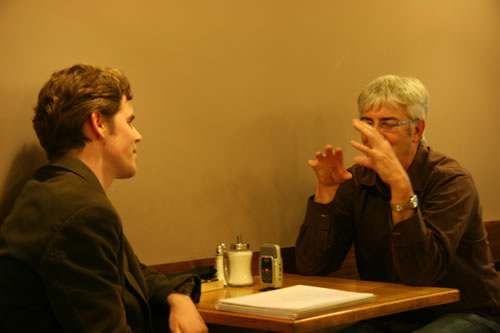
Sittin’: Another Interview with Shaun Micallef
By David M. Green
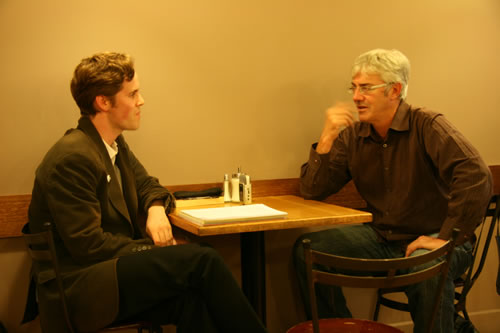
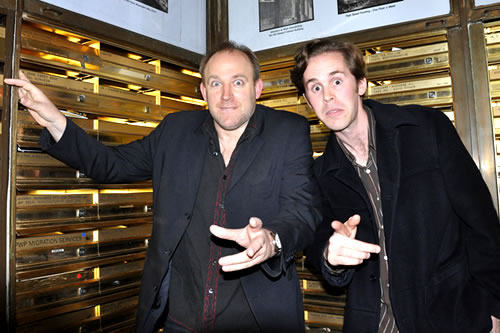
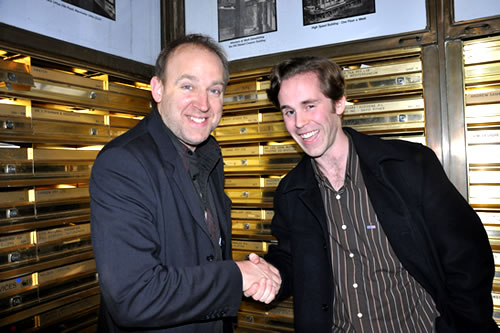
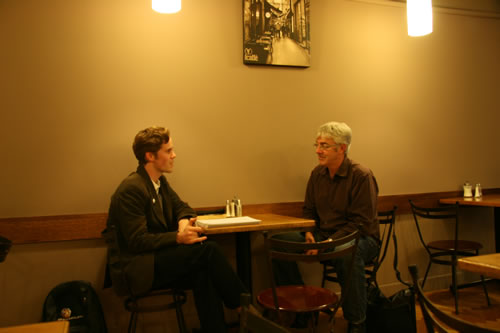
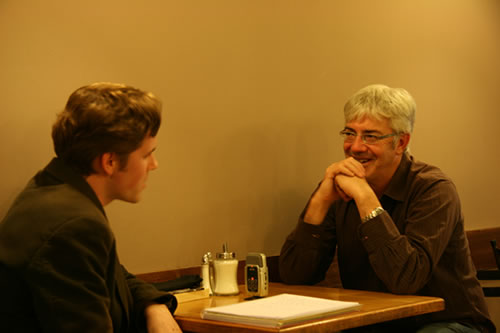
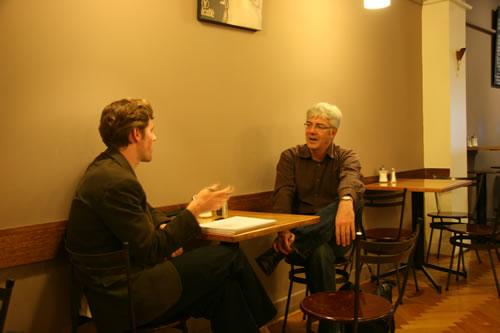
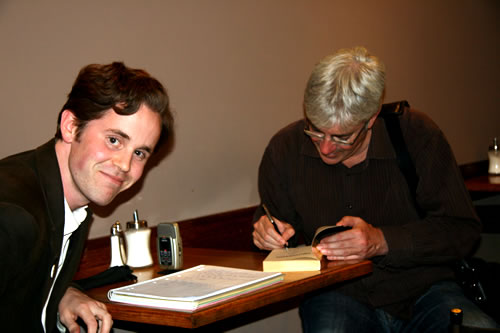
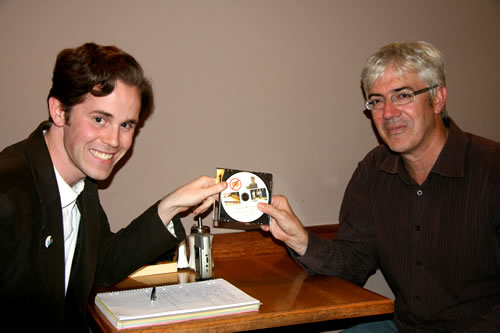
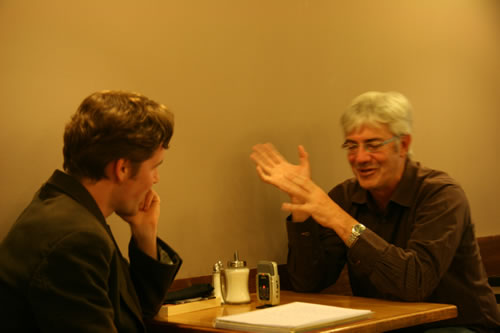
Serious, reflective, genuinely funny and immensely intelligent: My impression of TV’s Shaun Micallef after 50 minutes of his time, sitting in Druid’s Cafe on Swanston Street, March 31 2010. It had been four years since I first interviewed him, via phone, back on Radio Adelaide 101.5FM. So, I thought it was high time I once again exploited my position as an amateur media participant and caught up with him, just days after he’d received his first Gold Logie nomination.
David – Firstly, congratulations. How do you feel receiving this nomination now after having worked in TV for almost 20 years?
Shaun – Well nothing I know about the world makes sense any more. I worry. It’s a popular award, which suggests I’m doing something wrong. I’m incredibly suspicious. I assume some error’s been made in the tabulation process.
Do you feel you’re doing your best work now, on Talkin’ Bout Your Generation?
I was trying to think the other day about the best way to describe things and I think the show I enjoyed doing the most was probably The Micallef Programme. I think the best show in terms of comedy is probably Newstopia. I quite enjoyed that show and I’d happily make more. I think the most fun I’m having is probably Generation, so all three of those things are good things, there’s just different emphasis.
What do you think of the state of TV in Australia at the moment?
Well, I don’t really watch it, to be perfectly honest with you. I watch our show on Sundays. I watch the SBS News. I might watch the films on cable. I honestly don’t watch too much at all. I’ve missed the last ten years, really.
What was the last show you got into?
Frasier probably. That was the only one I’d seek out and that’d be it. I missed The Office. I missed Extras. I had to see it because I had to interview Ricky Gervais, so I watched the first series of Extras. I never actually saw The Office until somebody gave me a DVD of the American one with Steve Carell. I missed everything else. So anything kinda post-2000 I take it on peoples’ word about it, you know. Tony Martin’s forever recommending things, and he watches a lot. He gives me these DVDs and I go, ‘Yeah thanks, that’s great’ and I fully intend to look at them but I don’t have time to watch TV. It’s too much, too much to take in. But I have been catching up on some old films, Anthony Mann westerns and that sort of stuff, the work of James Stewart, so I’m actually going back in time and looking at work from the 1940s now. I live in the past.
What’s your favourite Jimmy Stewart film?
It’s a Wonderful Life. Anything from 1946 on you’ll see a mature Jimmy Stewart. Even in those weird westerns that he did, very, very strong actor. I know Jim Carrey’s a fan of his and I think fancies himself, in his dramatic roles, as a bit of a Jimmy Stewart. Can’t touch him really.
You do a good impression of Jimmy Stewart as well.
Yeah I like Jimmy Stewart. I can do impressions of people I like.
Do you find it’s easier to do an impression of someone if you’re actually doing an impression of someone else doing an impression?
Yeah, because someone cracks the code, I see what you mean. When I first saw Kevin Spacey doing Christopher Walken I thought, ‘Ah ok he’s doing that, those three things’ and then someone showed me a tape of Kevin Pollak doing Christopher Walken. He also does a very good Captain Kirk… Anyway, so I was watching him and I noticed, ‘Oh yeah, he does those other two things, that’s interesting.’ I’m not an impressionist, so I don’t go around thinking, ‘How do I crack that code?’ So for Walken, if I just do those four things, that’d sound like him… but it is easier when someone says, ‘Look, here’s the map.’ I can do a few though. I can do Jimmy Stewart but everyone in the world does Jimmy Stewart. Same with Christopher Walken. Everyone does Christopher Walken.
I think you were the first to sing David Bowie (as Walken)?
Yeah, I ploughed a pioneer trail there. Now everyone’s doing it.
That was on your comedy album that came out recently (His Generation). I’m not really a fan of musical comedy that much but I really loved ‘Dalgetty’s Fruit Wholesalers.’
Oh yeah, Gary McCaffrie wrote that. He wrote that for Newstopia. I wrote a little, I actually improvised a little conversation that preceded it, but yeah that was Gary’s. The chappy who produced the album, who’s the musical guy, he does all the music for the various shows we’ve done, Yuri Worontschak, it was his idea. He said, ‘We’ve got all this stuff recorded over the years, over the last 15 years,’ music beds and that sort of stuff that were just sitting in his computer, which were only ever used once, ‘Why don’t we do something with it?’ So we did, we sat aside and I found some old material that I hadn’t used for Newstopia, even some old stuff from The Micallef Programme, and just revisited it, shifted it and shaped it. Then with the success of Generation, the distributors, Shock, who did The Micallef Programme DVDs said, ‘Have you got anything for this Christmas?’ or whatever it was and I said, ‘Well, we’ve been mucking around on this CD for a while.’ Does anyone buy comedy CDs any more? Apparently not. Josh Thomas was telling me, ‘I’ve got an album in the top ten on iTunes,’ and I said, ‘Ah okay that’s great, can I get a copy of it?’ He says, ‘Ah, no, no it doesn’t exist, in any real sense. It hasn’t got a cover or anything. It’s just something that exists in the cyber world.’ So I should have cut down on my overheads and just not bothered having a real thing. So yeah, I think that’s his stand-up but I don’t do stand-up so I have to go to the effort of actually making something.
Yeah, you don’t really do stand-up. Did you ever try it?
Yeah, when I was writing for Jimeoin I did stuff at the Star & Garter Hotel in South Melbourne. Jim and Bob Franklin used to try their stuff out at the Star & Garter a couple of days before they did the show just to see how it went with the audience. Glen Robbins would do ten minutes and I was there every week anyway so I thought I’d just try my hand at it.
Didn’t care for it though? Or the audience didn’t care for it?
No, no it was fine, it went down all right. But again, it was a send-up of a stand-up act. It wasn’t really a stand-up act. Often the joke was me telling a joke badly so it was a meta-stand-up act. It was a joke about a joke, really, and that doesn’t sustain. I mean, it was fun but I think it would be ultimately bamboozling to anybody outside the scene. If you did it for real they’d boo you off the stage.
It’s interesting how you’re one of the most respected comedians in the country and you never really did stand-up, and there are all these stand-up comedians who just love you.
I don’t tell jokes! No, I can’t do it. I find it an interesting form and I love old joke-tellers and I love that sort of up-front entertaining. A lot of my friends are stand-ups and that’s sort of the go. It’s a fairly rough business. But I get a good deal of pleasure out of things not working, you know, I don’t really care enough about the response to be driven to do it, I suspect. It’s an intellectual thing. I think a live audience is really important, that’s why I’m doing this show with Stephen Curry, to tap back into that. Because my roots are review, I have a more actorly approach to it I guess, in that I’m playing some version of myself or some other character who is not necessarily aware that they’re getting laughs so I have to pretend that I didn’t hear the laugh whereas a stand-up can of course enjoy the laughter that he or she creates. It’s interesting. We do a little bit of direct address in this thing (Good Evening: The sketches of Peter Cook & Dudley Moore). It’ s a bit like what I’m doing as a presenter on TV, like with Generation, it’s sort of half for the audience for information and it’s half for the people who are sick and tired of hearing that sort of presentation and want a few jokes on it. Gary (McCaffrie) is not writing for Generation but he’s very good, as am I, I think in presenting that cliché-ridden crap that you get on TV and just subverting it slightly, just making people think about it, which was our undoing on Channel Nine I think because it was the perfect station to do a show like The Tonight Show on it but people wanted a proper show without any derailments in the way. So they were going, ‘Okay it looks like a tonight show, smells like a tonight show and wait… what? We’re seeing a chicken parmigiana? What?’ So I think it was just a bit bamboozling.
More blackface possibly?
Yeah maybe we should have gone down that route… Hey I’ve done blackface myself in a different sort of way.
Well you know, they’ve dragged Daryl Somers back, maybe in a few more years they’ll start doing through the other Channel Nine shows they axed?
You reckon? Yeah I don’t know I don’t think I’ll ever be retro chic, I suspect, for Channel Nine. Daryl had a good 20 years, 30 years, I can’t remember… Whatever it is. 13 weeks. You can hardly celebrate that. There are certain stations that I think I shouldn’t be on and I think probably Nine is one of them.
You’ve been on all of them now.
I have! Yeah finally, I think I lucked out with Channel Ten. They’ve seemed to warm to me.
When you started Micallef Tonight did you know that it was going to be axed?
Not when I started it. It was always two years. It was going to be a two-year plan, that’s what we’d agreed and they agreed, ‘Yes we need to give it life, we need to give it room to grow and turn into what it is.’ I said, ‘Look, it’s going to be really over-written when we start it but then gradually, once we find our feet, we’ll loosen up a little bit.’ I think we would have done that. As I recall Conan O’Brien took about four years to relax into the role and that was on every night of the week. But unfortunately at that point, 2003, the landscape wasn’t sufficiently comfortable with itself to allow you to find your feet. That’s the trouble with Australian TV. Unless you do it within two weeks or three weeks they just go, ‘That’s not going to work.’
Do you think it would be any different if you were doing it now in 2010?
I don’t know, I think it’s even harder. What was the show they took off Channel Seven after two weeks?
The White Room.
Yeah, yeah, you know. Maybe it’s no different. Let Loose Live was two weeks and from memory in the year I was doing the tonight show there was a show on Seven called Chatroom that lasted about two weeks and Amanda (Keller) was in it and Wendy Harmer was in it. They put Greeks on the Roof on as a replacement. That ran a series. But maybe that’s more to do with Seven because all those instances are Channel Seven pulling stuff off. But you know, they’ve got to pay the bills. I don’t blame them. You know, if it doesn’t work, if it doesn’t draw in sufficient audience to justify what they’re charging for the ads that’s just a commercial decision and they’ve got to replace it. But you know, you’ve got to ask, ‘Well, what did you expect?’ If you’re going to grow the thing somewhere and then put it on primetime… Maybe that’ll happen with digital. Maybe that’s the way. Now that they’ve actually just, all they’ve done is tripled the shelf space of their product. They’re not actually inventing any new stuff. They’re just splitting their advertising dollar. Instead of 800,000 people watching the station they’vegot 600,000 and 200,000 people watching the digital station. It’s the same audience. They might steal a few from somewhere else but it’s basically the same. So what do they do? They charge, you know, two fifths for that advertising. I don’t know, I’m not an executive producer at a network so I don’t know the answer. It just seems to me the pie is always the same size and it’s just the slices are getting thinner. I don’t know what the answer is. But I think you haveto do less now to stay on air. I think, you know, 700,000 people watching a show is a million people five years ago, because there are fewer and fewer people watching TV and more and more people watching YouTube or watching live streaming or making their own stuff or listening to podcasts or watching vodcasts, vidcasts, whatever they’re called. A whole lot of stuff, which is good. About time they had some competition.
Have you had a successful commercial show before Talkin’ Bout Your Generation?
Oh well I guess Full Frontal was successful. That wasn’t my show but I was in it. I produced. My first year I was writing and I produced in the second half of that year and gave myself an on-screen job as a result of that. Then the next year they said, ‘No we don’t want you producing. Just be in it.’ So I was happy to do that. That won Logies all the time. It wasn’t great but it was great apprenticeship and people liked it. People remember it far more fondly that they did at the time. We used to get terrible reviews, but now people go, ‘Ah, the glory days! Fast Forward and Full Frontal. Why don’t we make shows like that anymore?’ It’s because they had a good budget, which we used to built sets…
And smash them down.
We used to smash them down, you know. They don’t build sets for sketch comedy any more. They just don’t. They go and shoot it out in the real world so the range of stuff you can do, the range of approaches or attitudes of the realities of your characters, it’s all a bit too real. You ever watch Night at the Opera? The Marx Brothers film?
I’ve taped it but I haven’t watched it yet.
There’s a scene where Harpo is climbing up the outside of a ship and it’s an MGM film, the lighting is really real. The lighting it just a bit too harsh for these not terribly real characters. They’re much more at home in the studio than they are in the real world sometimes. You see, you’ve got to be careful how you present your comedy. If you say, ‘Oh we’ll just shoot it out in the street’ then you can’t shoot Milo Kerrigan in the real world. It’s not going to work. It needs to be a world with flimsy walls that can fall over.
And heads that fly around the room!
Yeah, that sort of stuff. Comedy climate. You can’t explain that to anybody. Ultimately it’s a budget consideration, because The Micallef Programme was the last sketch show that had a decent budget where you could hire a helicopter and film something that lasted four seconds. You couldn’t do that now, couldn’t justify it.
The Micallef Programme couldn’t be made today?
No, couldn’t do it today. When that finished that was the last time that anybody spent any money on a sketch comedy show.
Really?
Absolutely. That’s historical fact. That had a budget of over a million dollars for the series. I reckon each episode was about $300,000 so it would have been well over a million.
Was there ever a temptation to embezzle that money?
I think someone embezzled it, but not me. Production comedy obviously got a reasonable hunk of that as a profit but, you know, I work very cheap, I don’t know any better. Oh, I’ll just do it for this. I’ll just produce it for nothing and spend all the money on props and scenery and revolving sets and stuff that a sensible producer wouldn’t spend it on.
I enjoyed your New Year’s Eve Special. How did that come about?
Oh thank you. Actually I wanted a Christmas Special and then Granada, who produced Talkin’ Bout Your Generation, did it and the only other holiday left was New Year ’s Eve. I wasn’t entirely happy with it because I couldn’t hang around and do the edit on it. I had to go off for rehearsals for the stage show (Good Evening) because we were doing it in Sydney. I sat through one screening of it and I left them a bunch of notes basically and then went to Sydney and had to do it via email. Usually I sit in the edit suite and tighten it up. The other thing was it was supposed to be 90 minutes and I recorded extra material so we could cut it really tight, but they were so happy with the recording they said, ‘Oh, let’s make it two hours.’ So that extra half hour buffer I’d built into it ended up being in the show so it was a little looser than I’d want. It was a bit flabby. And two hours is too hard to sustain in comedy. But it was a sneaky pilot to see whether they were interested in doing a sort of sketch/variety show, which they ARE interested in so we’ll be doing that next year.
Is that where you want to get back into?
I want to do sketch but sketch is very hard to do now because of budgets. You go to the ABC with a sketch show and they’ll say it’s a light entertainment programme so the budget they offer is sufficient to make Spicks and Specks but it’s not sufficient really to make a sketch show.
The ABC doesn’t have a comedy department either do they?
No and they tend to regard sketch as non-narrative when it’s really multi-narrative, if anything, so it sort of needs a drama budget. So no they don’t have a comedy department, but I think they’re going to get one, so maybe they’ll change that. It’s a good training ground for comedy, I think, sketch.
Is there a Logie award this year for most outstanding comedy programme?
No, I supposed that’s indicative of that thing. They’ve combined it into light entertainment. You’ve got Generation for example, competing with Wilfred, bizarrely. So you’ve got a sitcom competing with a quiz show. That just doesn’t make sense to me. Odd. I don’t know why they got rid of it. They used to have one because The Micallef Programme won that one.
Did you watch John Safran’s Race Relations?
I did. I saw the first episode. I’ll be honest with ya, I didn’t get to see the others because I think we were shooting. It was on Wednesdays and we were shooting.
What did you think of that?
Um… well it was very brave of him. Uh… it reminded me, in a good way… he’s an agent provocateur. He’s a provocative presenter of ideas, so in that regard he’s like a punk Michael Moore in a way.
Did you watch a lot more television, say 20 years ago?
I watched a lot more when I wasn’t doing it, yeah I did. I sort of see the joins now, see the strings, see how it works and it’s not quite as interesting. I just don’t have time really. I’d rather spend time with the kids. We watch a lot of old shit. I watch Laurel and Hardy with them and I’ve just started introducing them to Buster Keaton. The good stuff.
How old are your kids now?
Twelve, nine and seven. Three boys.
Are they noticing you on the TV? Well, they’ve probably already done that, I imagine.
Well Generation and Thank God You’re Here are the only times they’ve really seen me on television because everything else is either before they were born or too late. They don’t watch the DVDs that we’ve got lying around. They just go on YouTube and watch a bit of Milo. They think that’s pretty funny. So that’s five years of my life now condensed to a two and a half minute, postage-sized screen and they go, ‘Ah that’s good, that’s what Dad did before we were born.’
Do you ever do the Milo Kerrigan character around the house?
Oh no no! The kids do it sometimes but it’s just so annoying when they do it…
And breaking things?
No, just the voice. They’d just be obsessed with it for a while, thinking it was very funny. Now they’ve grown out of it. Took them about six months. They’re over it now.
That character I think is unique because I can’t think of any other comedian in Australia who’s done a character you could compare him to.
Well Australian comics are very keen on characters. They love doing characters.
But not a mentally ill ex-boxer who smashes things!
No, that’s true, no one as violent as that, I suppose. I think Lano and Woodley did some wonderful stuff. They’re the only ones I ever look at it. Maybe earlier Los Trio Ringbarkus, which would be before your time. It was Neil Gladwin and Steve Kearney and they were very physical and Lano and Woodley are very physical but there’s not too many others who are very physical. Frank I think is just a genius and actually Glen Nicholas, the way he mimes, he’s a genius too. Those two are very different but very good physically and I can’t think of anyone else who really does it here. It doesn’t seem to have been a tradition in Australia for some reason.
Physical comedy?
Not physical comedy, no. Not at all. It’s either stand-up or it’s, you know, well-drawn characters like Humphries does.
Last year I saw you on 9AM with Dave & Kim where Martin Short was a guest host and it was just a magic TV moment. I could tell you were quite obviously thrilled to be there.
Yeah, yeah I was, I was. It was quite a thrill to meet him and he did a show here and he asked me to help out. He does his Jiminy Glickcharacter at the end and interviews someone. I think Rove did it one night and I did it another night, so I got to come on and ad-lib with him, which was fantastic. That was great. Obviously he had a bit of his prepared shtick, so he does all that. But then I can contribute, I was playing straight to him. I knew what he wanted, what he needed, so I’d throw him a few things and we went off on a bit of a riff on that. So that was a bit of a thrill. I think the kids and I had just seen Santa Clause 3 where he plays the evil guy, Jack Frost, and when he rung up and thanked me I held it up to the kids, said listen to this: ‘Hi Shaun it’s Marty Short here…’ Kids were very impressed. And that’s funny because he’s a product of the same sort of influences that I am and he must be 60, I think. He loves physical stuff, he’s very broad, loves Jerry Lewis, you know that sort of stuff. And because he’s Canadian like Jim Carrey, he’s willing to do anything to get accepted by an American audience. You’ll find the Canadians will really exert themselves to get the laughs.
Mike Myers?
Yeah, Mike Myers, John Candy, all that bunch. Dan Aykroyd.
On the TV show, I think it was quite obvious as well that you and Martin Short were operating a completely different level to Kim.
Yeah, David wasn’t there but Martin was replacing David for that show. I remember I said to Martin, ‘They call them Stobey Poles in Adelaide.’ And she says, ‘Oh I thought that was a cigar?’ and Marty and I both at the same time said, ‘No, no that’s a stogie.’ Like, we know. And we were talking about shtook, shtick and tookus…
Another funny moment, I remember you were talking about voices and Kim said, ‘Can you do the thing where you drink water?’ And you said, ‘Yeah Martin! Can you drink water?’
(laughs) Yeah, Marty knew.
Can I ask you about Richard Marsland, because you worked with him on Newstopia? (Comedy writer and Melbourne radio personality Richard Marsland committed suicide in December 2008 at the age of 32)
Yeah, well I knew Richard before Newstopia because he worked with Tony and he was a bit of a comedy nerd, like us, that we all are, who can talk for hours. Did you know him?
Yeah, I did. I interviewed him once and came to Melbourne and had lunch with him once. Because I was a panel-operator at SAFM, and he used to do that as well, I was becoming friends with him, but I was more of an acquaintance.
He was a lovely guy and he worked with Tony and Ed for that two year period and that’s when I got to know him. I wouldn’t say I knew him very well but I knew him enough to rate him as a comedy creator and a writer and uh, in between his other commitments, he seemed to be writing for a lot of other shows that we didn’t even know about. He seemed to be doing a lot of work for other people as well and he’d still come in and give us a couple of mornings a week and uh, quite chameleon in terms of what styles he could do, I think. I sense there was some frustration in terms of getting to do his own stuff. I think he probably would have loved to have his own, you know, machine. I think that he was far too… he was far too busy helping everybody else. He was very generous, generous with his time and I think you would have found him too.
Did you ever suspect that he was depressed?
No, no I didn’t know him well enough to… you know, things sort of make sense in retrospect, I think. How can anybody be that apologetic about being on time for something? He would always be amazingly apologetic when he’d give you the material. You know, he’d be talking it down as he gave it to you, which in the absence of what happened is charming and it’s funny and it’s Richard but after what happened you go, ‘Ah, well that’s a sign that maybe some of us should have been able to interpret.’ You know, that’s somebody who’s worried about letting you down, and if you do that to everybody, if you worry constantly about letting everybody down, I mean I didn’t know how many people he was writing material for but imagine doing that five, six times a day. If you were worried, if you were genuinely worried about whether you were coming up, whether you were reaching the mark where you want to reach, it’s gotta wear you down, unless you’re getting endorsement from everybody. I don’t pretend to know him or know what it was or what slow trigger it was but it… it was very, very sad.
Did you choose the writing staff for Newstopia?
Yep, yeah… A long time ago I learnt that I’d never have a writing staff that was put together by anyone but me. And usually I don’t actually think of them as writers, you know, we’re all mucking together. I’ll sit in there and I’ll be working in there and because I’m a writer first and foremost, I get it, you know. If I was a comic who relied on writers it’d be a different relationship, but Michael Ward and Gary McCaffrie, we share the co-creator role for Newstopia. We are equal partners and I always look at that, whenever it’s one of my shows the writers will always have a producer responsibility for it. They own it. They are the producers, they can say in how it’s cut. Michael Ward wrote the sketch where I dressed up as the Dalai Llama, don’t know if you’ve seen that one?
Yeah, excellent impression.
Yeah, he wrote it and I said, ‘What do you think of that, I added some stuff?’ I put some obscure Scorsese references there because he did Scorsese Casino and I threw in some Mean Streets or something like that. Johnny Boy. He liked it, made some suggestions about cuts, that’s great. Same when Gary comes in and looks at it and says, ‘Well that’s a bit long’ or whatever. Um, so yeah the creative process is not just limited to an assembly line, where you do your writing and that’s it, that’s your responsibility. Richard as well, you value his opinion. You say, ‘What do you think of that? Is that too slow? Is that too many beats?’ And we all know the same rhythm, and the person who writes it should be the person who signs off on it. That’s the tradition in America. All the writers for sitcoms become the producers for that episode. But over here writers are regarded as interchangeable, you know, you can be the greatest sketch writer in the world like Gary McCaffrie and they’ll see you the same as some shit-kicker who shouldn’t be writing advertising copy. You know, because there’s people who can’t do it. There’s just people who are better. A lot of TV people just can’t see the difference, ‘Oh, you write. You’re a writer. You write jokes.’ That’s not quite right. That’s where you get into trouble I think.
Do you think that’s something more common to Australia just because our television industry is a bit more… infant?
Yeah there’s not enough, that’s right. A. There’s not the audience to sustain that niche programming, you know, if we had the audience that they have in America then you can make a living out of being very strange and doing a lot of bizarre things. There’s a comic called Sam Simmons, who I think is brilliant. He’s the next big thing as far as I’m concerned.
I heard you on Triple J with him.
Yeah, he’s great. I rate him very, very highly. Very original thinker. Nice guy too.
I remember reading an article about Sam Simmons once and he said you are his biggest influence, but he also said he hates Monty Python.
Does he? Ah okay (laughs). He probably hates the way it’s aped, probably. It’s hard to watch Python now without the hype of its own reputation hanging over it. So if you’d never seen it before and you didn’t know anything about it and you watch it, it does look pretty crappy. It’s crappy TV. And there are a lot of misses in there. People who love it will forgive it. And also if you’ve been told constantly how hilarious it is and then you turn it on, you’re going to be sitting on your hands anyway when you watch it.
Do you feel the same way about Peter Cook and Dudley Moore?
What, that I hate them?
(laughs) No, no that their reputation precedes them. They have a huge shadow.
Um, no I think sadly they don’t have a reputation unfortunately. In a way that was the motivation for doing this show, to have the material be seen as it should be on stage and experienced. I was talking to my 18-year-old nephew and he’d never heard of Peter Cook and Dudley Moore. Of course he hadn’t heard of them. There’s no reason. There’s no shows available. Uh, hadn’t even heard of Dudley Moore. But they’re the greatest sketch writers around, you know. They write very different to Python. Python are very much about form. Fomat sketches where they’d sort of empty the content out of a quiz show and then put in some odd thing that’s held together by the format of a quiz show or the format of a pet salesman dealing with a complaint from a customer and all those sort of rules and regulations that hold those things together. Cook and Moore’s stuff is more character-driver and it can go anywhere. It can go where ever it likes. That stuff’s quite rare, you don’t really see that much of that sort of stuff.
Did you and Stephen Curry get together and think about this?
No it was my idea, really. Stephen was brought in when we were into the casting of it. Good choice. Performing with him and seeing what he does with the material and with me makes me realise how lucky we were that we got him, because there was a question mark over whether he was going to be able to do the touring season of it and I can’t think of anyone who would be a suitable replacement for him.
You’ve known him previously?
Yeah, I’d worked with him on The King, but I’d known him for years anyway because he was friends with Bob Franklin and Rossi’s (Roz Hammond) and we sort of mucked around together, the new members of that group.
Have you had any contact with Britain or the United States? Could you see yourself going there and trying it there?
No, no. Too old. Too old. But, Dan Patterson who’s the creator of Who’s Line in England, he and I had a correspondence for a while because he really liked The Micallef Programme and wanted to do a show like that in England, so I was going to go over and do an English version but yeah, it didn’t pan out. That was a few years ago, but I speak to him every now and again. But I’m happy here. It’s too late to start again. I think it would be very demoralising. I’ve got kids, I’vegot family, but really I’m just not interested (laughs). At the end of the day I don’t give a fuck. I just like doing what I do and I’ve got enough freedom here to do what I want to do. Even before Generation I seemed to be able to do what I want to do. Newstopia was a great show to do and I’d do it at the drop of a hat again. I really enjoyed doing it and I’d be more than happy being ten o’clock on SBS on Wednesdays. So the success of Generation will allow me to play in a few other pools, doing some odd things here and there. Probably a couple more years. That’ll do. That’s absolutely fine with me.
There must be times when the weight of ‘the biz’ comes down? Has there been any times recently where you’ve regretted giving up being a lawyer?
No, no it’s a joy and the other thing I like about it is I can take my kids to school and pick them up and the time is my own to do with what I want and if I don’t want to work for a month I don’t have to work for a month. It’s great. I mean, I’m increasingly getting lazier and lazier. I’d rather not work at all, to be perfectly honest. I’ve given up producing other people and directing other people, I suspect, but being in front of the camera, I’ll continue to do that. I’ve had the luxury of being able to do exactly what I’ve wanted to do on a number of occasions for TV shows, so it’s not like I’ve got that burning need to be free of the oppressive constraints of other producers and bad writing.
You’ve been through that already?
Well I did that with Full Frontal and even that wasn’t too bad. That was me learning. And then the next job I had was my own show that I could do whatever I wanted with so it’s fantastic. Very lucky man, you know. And I was only 34 or something like that. It was great to be able to do that. So everything else has been a bonus.
Do you feel that now you’ve gone back onto a bit of a more mainstream audience you’re getting noticed more? Is it difficult to get out in public?
No, it doesn’t bother me at all. People come up to me and say they enjoyed, actually more people come up to me about Newstopia than they did for any of the other shows. The other thing it’s because I wear glasses and dress like a bum, people think I look like the guy maybe. They don’t think I am the guy. I think if you conduct yourself as a star, you’re going to get people looking at you. If you, as I did, jump on the Circle Tram and come down here from the Docklands car park, no one’s gonna bother you.
I could of course have kept asking questions forever, but Shaun had places to be. Namely, The Comedy Theatre on the corner of Exhibition and Lonsdale Streets for Good Evening: The Sketches of Peter Cook and Dudley Moore starring Shaun Micallef & Stephen Curry, which is running until April 11 as part of the Melbourne International Comedy Festival. I got the impression Shaun is a man very content, able to do essentially whatever he wants, just for the love of it, and in the fickle world of show business, at least in Australia, that’s very rare indeed.
Kind regards,
David M. Green